Rural Damascus — Daraa, Syria
Syrians Building Again
The Route Was Built 321 Times
A 400 kV line across southern Syria looks like one continuous corridor. It began as hundreds of separate holes in the ground, each needing its own road, its own foundation and its own proof.
By The Bayt Syria infrastructure desk
18 February 2021
10 min read
Daraa
A transmission line is measured in kilometres.
It is built in locations.
On paper, the Rural Damascus–Daraa 400 kV transmission line formed one route extending approximately 107 kilometres between the governorates of Rural Damascus and Daraa.
On the ground, it became 321 separate construction problems.
Before any conductor could run continuously across the route, crews had to reach each tower position, confirm its location, prepare the ground, construct its foundation, erect the correct tower and connect it to the line's protection systems.
The project was delivered by International Consolidated Contractors Offshore SAL, also known as ICCO, for Syria's Public Establishment for Transmission and Distribution of Electricity.
Its completed form is linear: one double-circuit transmission line stretching across southern Syria.
Its construction was anything but linear.
One corridor, 321 beginnings
A route drawing can make a transmission project appear continuous from the start.
In reality, continuity comes last.
The first stage is to divide the proposed alignment into individual tower positions. Each location must be surveyed and set out precisely because its position affects the spans on both sides.
Move one tower, and several things may change:
- the distance to neighbouring structures
- conductor sag
- ground clearance
- the direction of the route
- structural loading
- foundation requirements
- access for construction
The Rural Damascus–Daraa line used 321 tower positions to carry its two 400 kV circuits.
Each position was part of the same electrical design, but it still had to be treated as an individual site.
A tower could not be erected simply because steel had arrived. The ground beneath it first had to be understood and prepared for the forces the finished line would place upon it.
Access became part of the engineering
A transmission tower can only be built after people, concrete, reinforcement steel, machinery and tower components reach its location.
Existing roads rarely provide complete access along a long overhead-line route.
For the Rural Damascus–Daraa project, approximately 42 kilometres of access-road work supported construction across the corridor.
These roads were not separate from the main project. They made the project possible.
Excavators needed routes to tower positions.
Concrete materials had to arrive before foundation pours.
Steel sections had to be delivered in the correct sequence.
Cranes and erection equipment needed suitable ground from which to operate.
Later, stringing teams, inspectors and testing personnel had to return to the same locations.
A tower route therefore creates two corridors.
The visible corridor carries electricity after completion. The temporary and permanent access network carries the project while it is being built.
The ground changed the work
The route required approximately 38,000 cubic metres of ordinary excavation and another 4,200 cubic metres of rock excavation.
Those two quantities reveal an important feature of long-distance infrastructure: the construction method cannot remain identical from one position to the next.
At some sites, conventional excavation could prepare the foundation area.
At others, harder material required a different effort, different equipment or more time.
The project could use common engineering standards across the route, but the ground still determined how those standards were achieved at each location.
This distinction matters because a tower foundation is not merely a concrete base holding the structure upright.
It must resist several forces at once:
- the weight of the tower
- wind acting on the structure and conductors
- the pull of tensioned cables
- forces created where the route changes direction
- unbalanced loads during construction or abnormal conditions
The foundation transfers those forces into the surrounding ground.
Its design must therefore reflect both the tower's duty above the surface and the conditions beneath it.
The infrastructure that disappeared underground
Much of the project's physical scale became invisible after construction.
The completed route incorporated approximately 16,800 cubic metres of reinforced concrete and about 2,550 tonnes of reinforcement steel across its tower foundations.
Once backfilling and compaction were completed, most of that material could no longer be seen.
Only the tower legs emerging from the ground indicated the extent of the work beneath them.
This is one reason transmission-line construction can be visually misleading.
The steel tower attracts attention because it rises above the landscape.
Yet the structure's stability depends on excavation, reinforcement, concrete, tower stubs, backfill and soil compaction that disappear before the conductors are installed.
The Rural Damascus–Daraa line was therefore already a substantial civil-engineering project before it became an electrical one.
Four tower families divided the mechanical work
The route did not use one tower design repeated 321 times.
It used four principal structural categories:
- 230 straight suspension towers
- 70 medium-corner towers
- 17 heavy-tension towers
- four terminal towers
The number of suspension towers reflects the long sections where the route remained comparatively straight.
At those positions, the conductors continue through suspension insulator strings, with the pull from one direction largely balanced by the pull from the other.
Corner towers have a different responsibility.
Where the alignment changes direction, the conductors pull the structure from different angles. The tower and foundation must resist the resulting sideways forces.
Heavy-tension towers perform a more demanding anchoring role. They divide the line into mechanically controlled sections and carry greater unbalanced conductor forces.
Terminal towers stand at the points where the overhead-line system reaches an endpoint or transition. Rather than allowing conductor tension to continue into another span, they must restrain it.
These structures all belong to one route, but they do not experience the route in the same way.
The tower schedule records the geometry of the line in steel:
230 positions where it continued.
70 where it turned.
17 where greater restraint was required.
Four where the overhead system reached a terminal point.
The moment separate sites became one line
Until conductor stringing began, the project remained a sequence of individual structures.
The towers could be complete and correctly positioned, but they were not yet functioning as one transmission system.
That changed when conductors were drawn across the spans.
The Rural Damascus–Daraa project involved approximately 2,568 kilometres of phase conductor.
The quantity is far greater than the geographical length of the route because the line carries two three-phase circuits, with multiple conductor elements extending through the complete corridor.
Stringing required conductors to be pulled through temporary running equipment across successive towers.
They then had to be adjusted to the correct sag.
Sag is not an imperfection in an overhead line. It is the calculated curve that allows a conductor to span the distance between towers while maintaining the required balance between tension and clearance.
Too much sag can reduce the distance between the conductor and the ground.
Too little sag can place excessive mechanical force on the conductor, tower and foundation.
The correct result changes with span length, conductor properties and expected temperature conditions.
For the first time, work completed separately at hundreds of locations became physically continuous.
A foundation error at one position could now affect conductor geometry across neighbouring spans.
A tower installed incorrectly could interrupt the sequence.
The line only became continuous because the earlier work at each site had been completed accurately.
Thousands of small components controlled the conductors
A transmission conductor may appear rigid from the ground.
It is not.
Wind can cause movement and vibration. Long spans expand and contract with temperature. Bundled conductors must remain separated while responding to changing mechanical conditions.
The Rural Damascus–Daraa project included approximately 8,200 bundle spacers and 5,400 vibration dampers.
These components are much smaller than the towers, but their work continues throughout the life of the line.
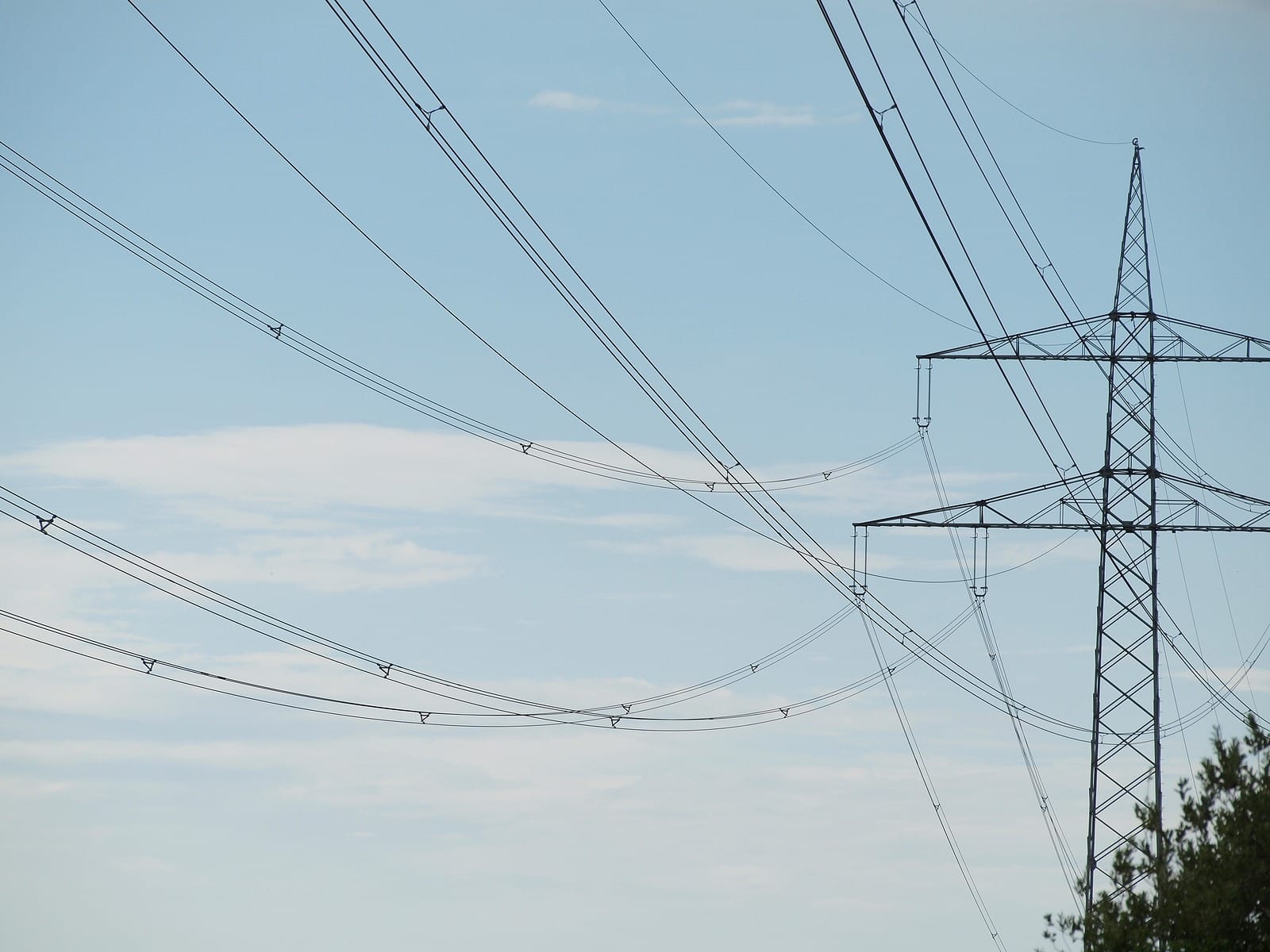
Bundle spacers maintain the required distance between conductors forming the same phase bundle.
Vibration dampers reduce wind-induced oscillations that could otherwise place repeated stress on conductors and fittings.
Insulator strings carried another responsibility.
They supported or anchored the conductors while separating the energised system from the steel towers.
The project used different insulator arrangements for suspension positions and for corner, tension and terminal structures, reflecting the different mechanical duties along the route.
The line's large scale therefore depended on thousands of smaller interventions repeated span after span.
Two additional paths ran above the phases
The main conductors were not the only cables extending across the 107-kilometre corridor.
The project also included approximately 107 kilometres of conventional earthwire and a similar length of Optical Ground Wire.
Placed above the phase conductors, these wires form part of the line's lightning-protection system.
Their elevated position makes them more likely to intercept a direct lightning strike before it reaches the energised conductors below.
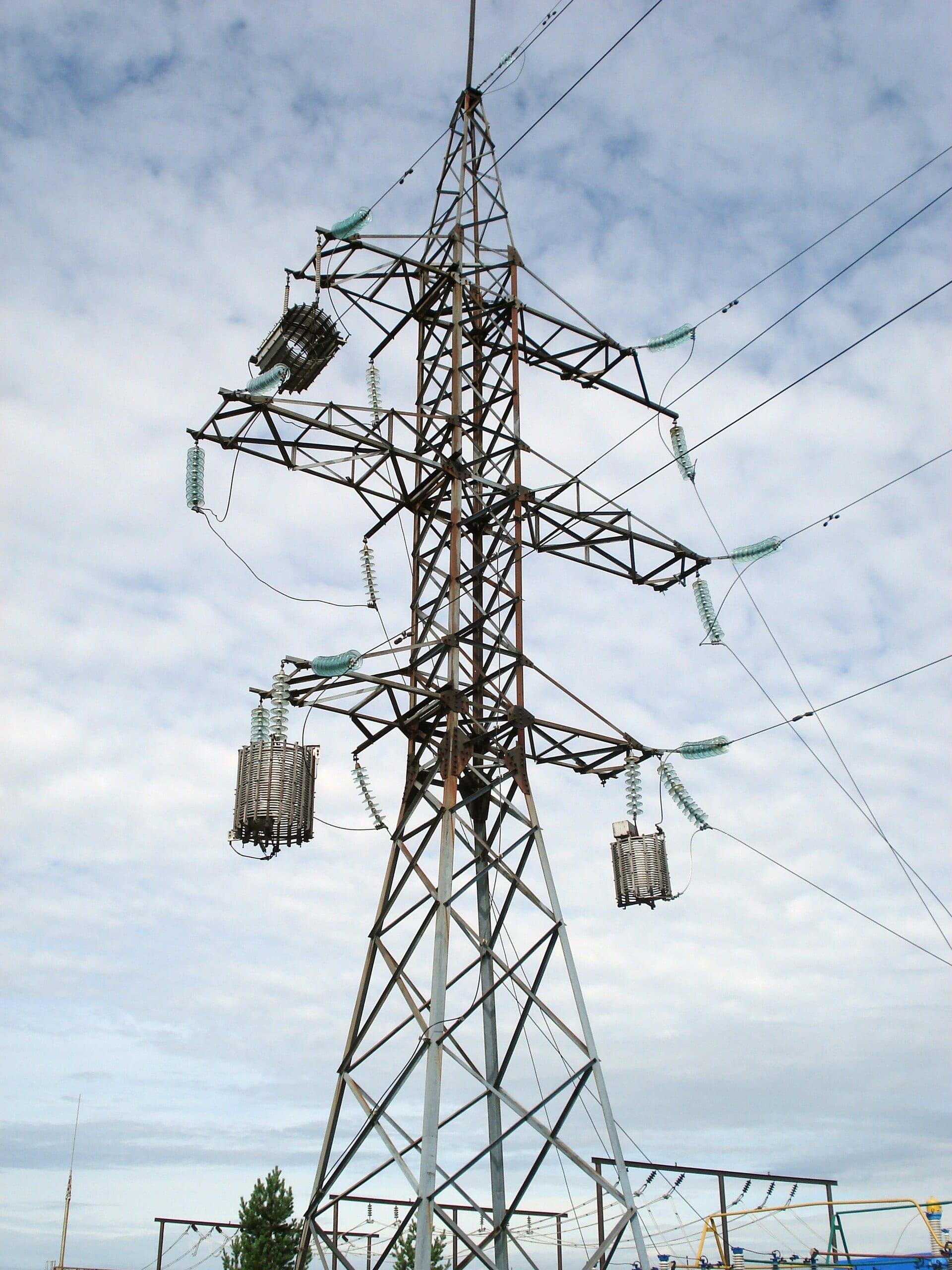
Optical Ground Wire, commonly known as OPGW, performs a second function.
Inside its protective metallic structure are optical fibres capable of carrying communication, protection and operational data between connected grid facilities.
This means the completed Rural Damascus–Daraa line carries two kinds of continuity.
The phase conductors carry electrical power.
The OPGW carries information needed to monitor and protect that power.
The communications system is not visible from the ground, but it allows equipment separated by more than 100 kilometres to exchange signals as part of one network.
Every tower needed a path into the earth
The line was designed to keep its high-voltage conductors electrically separated from the towers.
It also required every tower to be connected deliberately to the ground.
Earthing provides a controlled path for lightning and fault current to move from the structure into the surrounding soil.
All 321 tower positions received grounding installations and resistance testing.
At 84 locations, the standard arrangement required additional enhancement.
This is another example of one common design producing different site-level responses.
The same line voltage crossed the entire route.
The same broad protection principle applied to every tower.
But the electrical relationship between each grounding system and the surrounding earth was not automatically identical.
Testing determined whether the installed arrangement achieved the required result.
Where it did not, additional conductors extended the effective grounding system.
The line's protection was therefore built both above and below the surface.
Earthwire and OPGW intercepted electrical events at the top.
Tower steel carried current downward.
The buried grounding network dispersed it into the earth.
Completion happened position by position
A 107-kilometre transmission line cannot be verified through one final test at one location.
Its completion depends on evidence distributed across the entire route.
- Tower installations had to be inspected.
- Bolted connections required verification.
- Conductor tension and sag had to be checked.
- Insulator strings, fittings, spacers and dampers needed inspection.
- Grounding resistance had to be measured at every tower position.
- The OPGW route required optical testing to confirm that its fibre links were continuous and operating within acceptable limits.
Only after the separate civil, structural, electrical, grounding and communication systems had been checked could the project be treated as one operating line.
The Rural Damascus–Daraa project began in August 2018. Mechanical completion was reached in January 2021, with final handover following in February 2021.
Those final milestones represented more than the end of construction.
They marked the point at which 321 local sites could be accepted as one connected transmission asset.
ICCO's work across the corridor
International Consolidated Contractors Offshore SAL delivered the line through a turnkey scope covering design, supply, construction, installation, testing and final grid integration.
That required several disciplines to move through the route in sequence.
- Survey teams established positions.
- Civil teams prepared access and foundations.
- Structural crews assembled and erected towers.
- Electrical teams installed insulators, conductors, earthwire and OPGW.
- Grounding teams completed and tested the tower connections.
- Commissioning personnel verified that the route could operate as one system.
The work did not advance as one crew travelling from the first kilometre to the last.
Different activities overlapped across different sections, each dependent on what had already been completed at the individual tower locations.
The project's management challenge was therefore geographical as much as technical.
Materials, teams, equipment and inspections had to reach the correct position at the correct stage.
One line made from hundreds of completed places
The completed Rural Damascus–Daraa 400 kV transmission line can be described in a few figures:
107 kilometres.
321 towers.
Two high-voltage circuits.
But those numbers conceal the method by which it was created.
- The route was surveyed one position at a time.
- Access was established site by site.
- Foundations were adapted to different conditions.
- Four tower families divided the structural work.
- Conductors connected previously separate locations.
- Grounding tests confirmed the performance of every position.
- Fibre testing confirmed communication across the complete route.
Only at the end did the project become what it appeared to be on the original alignment: one continuous line between Rural Damascus and Daraa.
It was drawn once. It had to be built 321 times.
Context
- What 400 kV means here
- Syria's transmission network moves bulk power at high voltage between generating stations and regional substations, then steps it down for distribution. A 400 kV double-circuit line is transmission infrastructure rather than local supply: it is the level at which one part of a country's grid is connected to another, and a fault on it is felt far from where it happens.
- Who built it, and for whom
- International Consolidated Contractors Offshore SAL — ICCO — delivered the line on a turnkey basis for the Public Establishment for Transmission and Distribution of Electricity, the Syrian body responsible for the transmission network. Turnkey means one contractor carries design, supply, construction, testing and grid integration rather than coordinating those as separate packages.
- Why sag is a design figure
- The curve of a conductor between two towers is not slack that crept in. It is calculated. Sag balances the mechanical tension in the cable against the clearance needed beneath it, and it changes with span length, conductor weight and temperature — a line strung in winter will hang lower in August.
Photographs
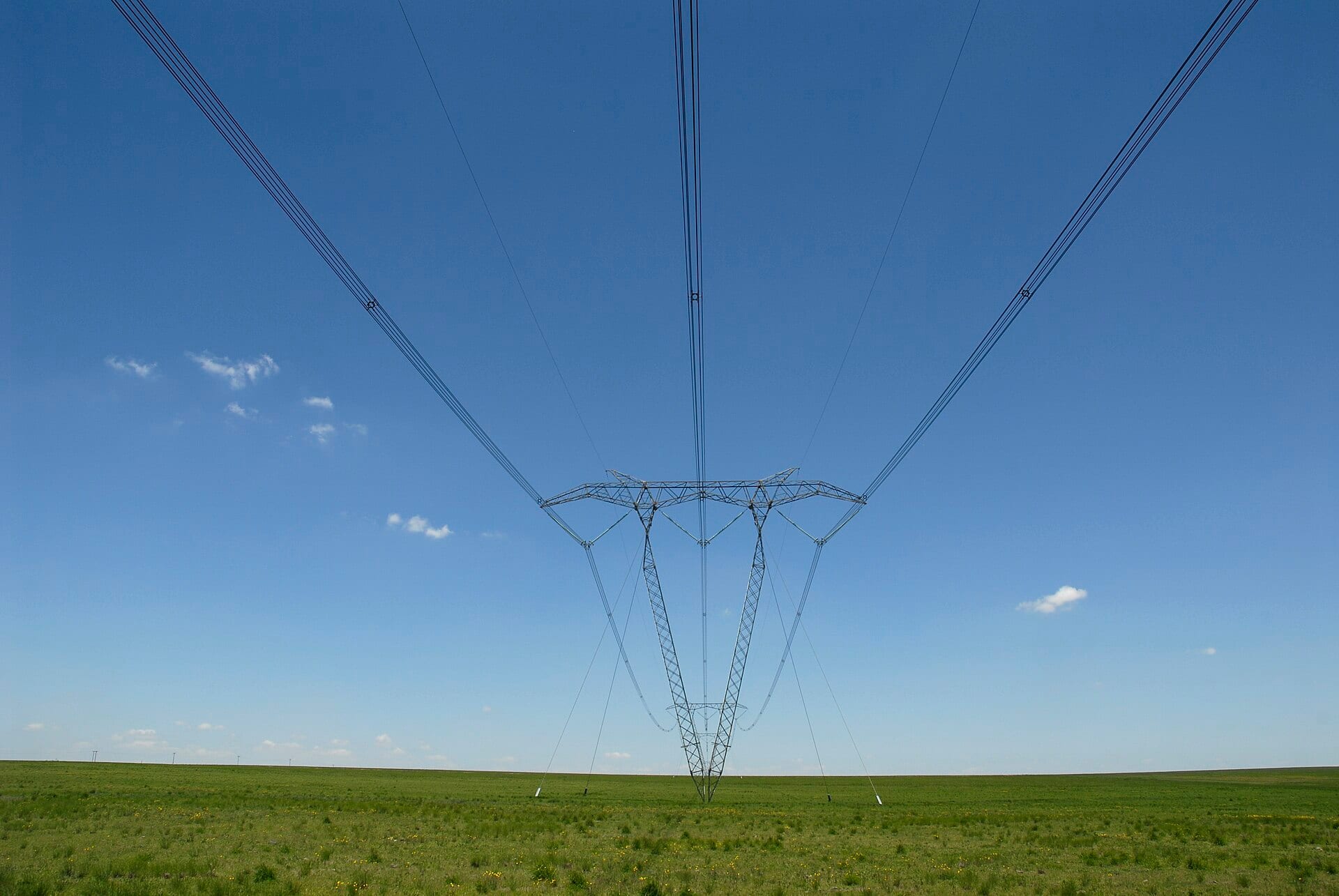
- A guyed suspension tower on open grassland in Gauteng, South Africa. Suspension towers are the type used at the 230 straight positions on the Rural Damascus–Daraa route. Graeme Williams, Media Club / Wikimedia Commons (CC BY-SA 2.0) · Source
- Vyacheslav Argenberg / Wikimedia Commons (CC BY 4.0) · Source
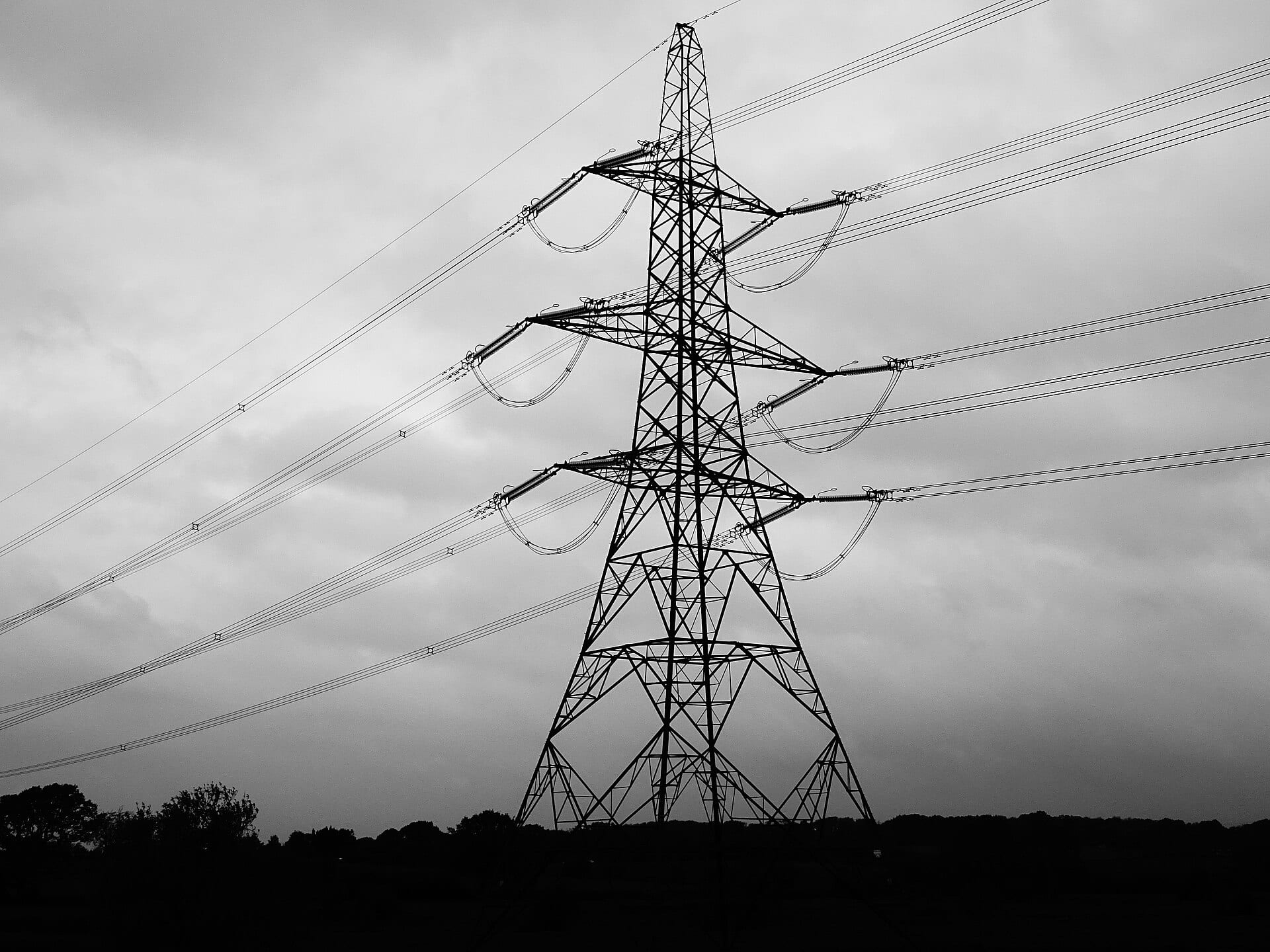
- A dead-end tower photographed in southern England. The looping jumpers show the anchoring duty that heavy-tension towers perform — 17 of them on the Syrian route. EVERYMAN FILMS / Wikimedia Commons (CC BY 2.0) · Source
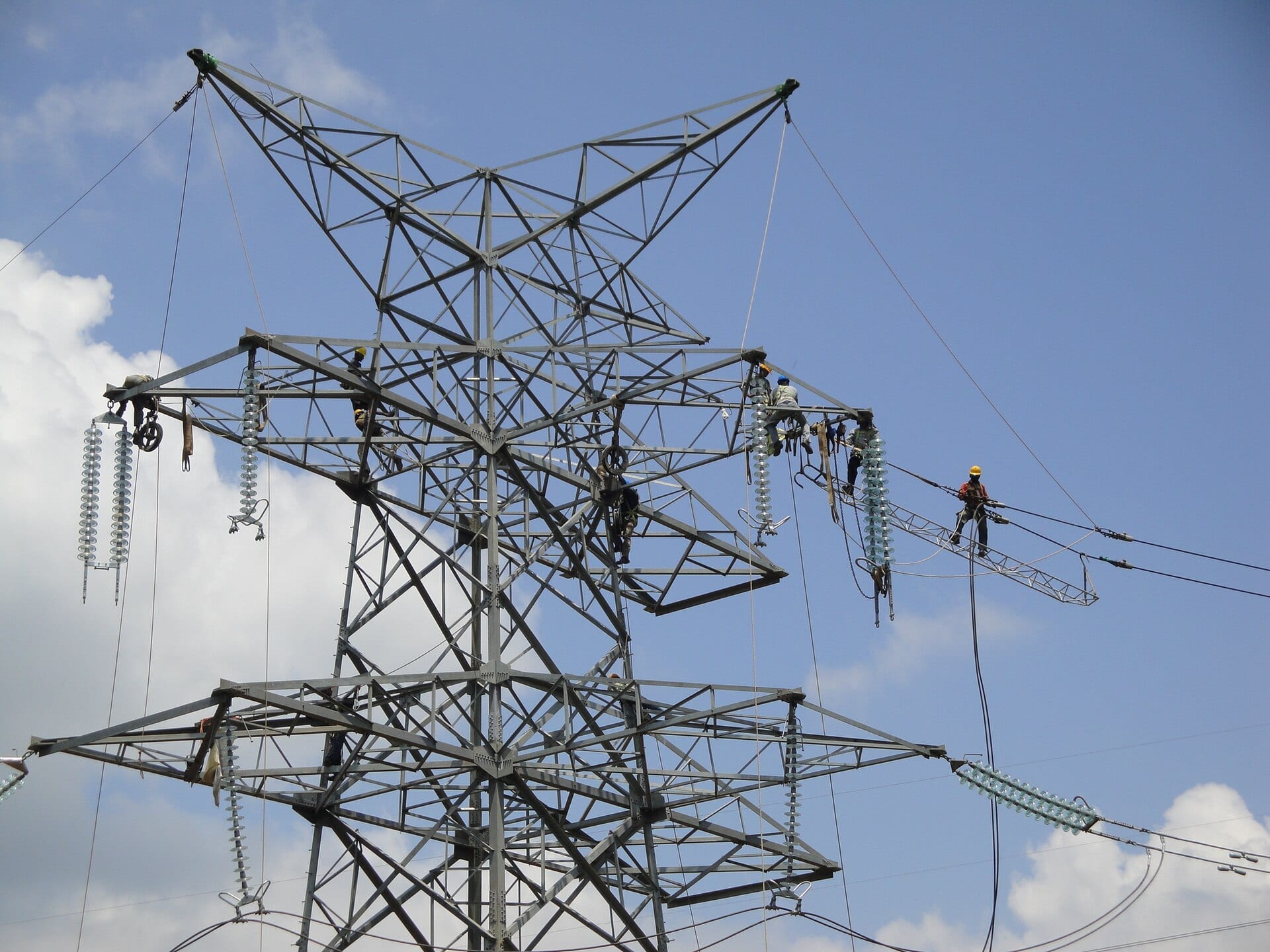
- Conductor stringing in progress in Sri Lanka. It is the stage at which separately built tower positions first become one continuous line. Chathuranga Perera (Bcpadd) / Wikimedia Commons (CC BY 3.0) · Source
- Bundle spacers on an overhead line in Germany. Roughly 8,200 of them were installed on the Syrian route. Kreuzschnabel / Wikimedia Commons (CC BY-SA 3.0) · Source
- A tower carrying line traps and an optical fibre cable. The Syrian route runs about 107 km of Optical Ground Wire in the same top position. Den Siaopin / Wikimedia Commons (CC BY-SA 3.0) · Source


More from Daraa
Related stories
Rural Damascus, Syria
A Grid Is an Argument About What Happens at Seven in the Evening
Transmission capacity is discussed in megawatts and decided by habits. Everyone wants power at the same hour, and that hour is what the whole system is built for.
1 February 2021
Daraa, Syria
Daraa Was a Junction Before It Was Anything Else
The Hejaz Railway made the town a place where two directions met. A century later a 400 kV line crosses the same ground, for the same reason.
12 November 2020
Damascus, Syria
The Hour Before the Shops Open
A letter about the part of the day nobody photographs, and the small economy that runs inside it.
11 February 2021